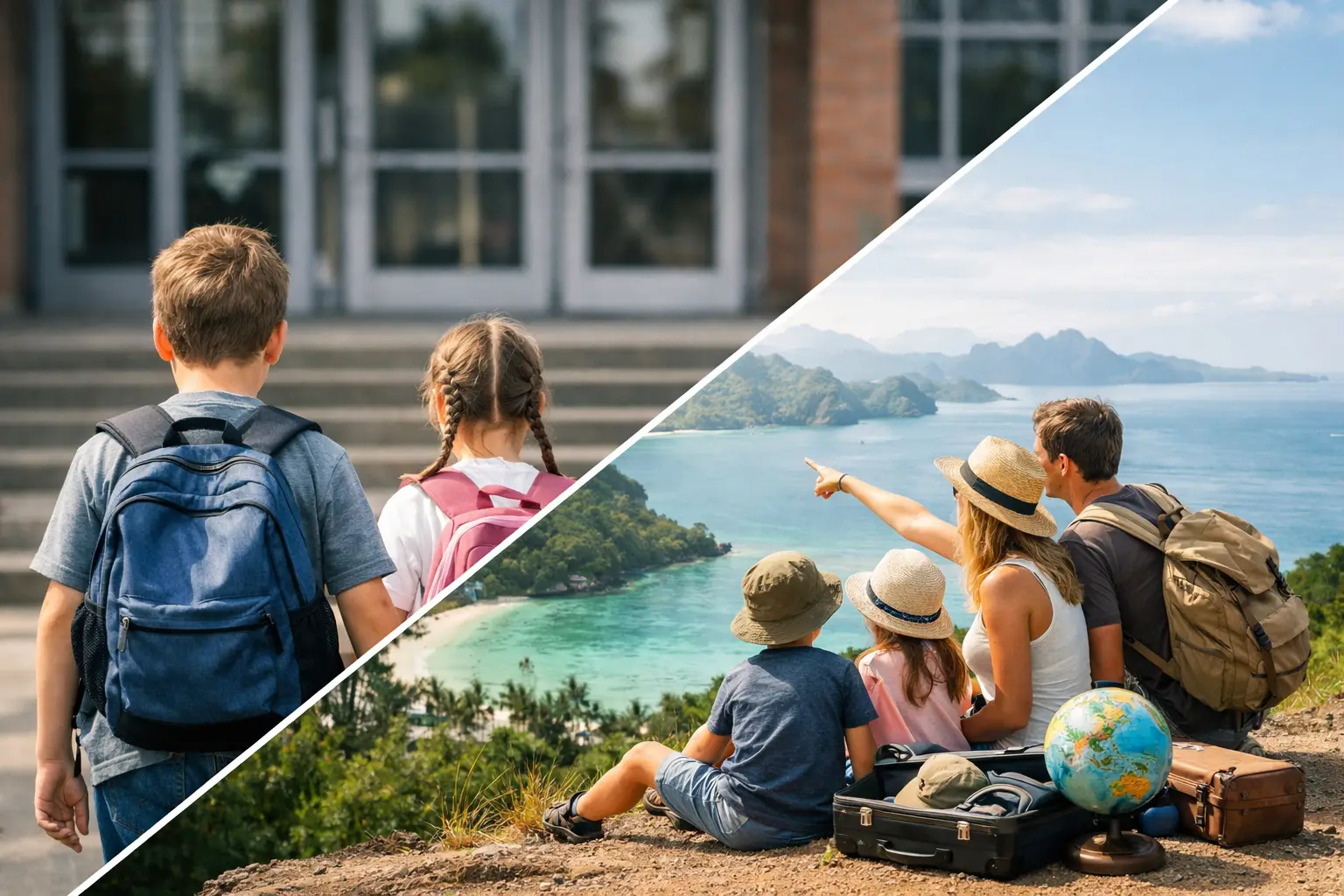
The actual question is rarely just compulsory schooling or world trip. It's more: are we allowed as a family to live differently, without taking something away from our children? That's exactly the point where many parents sit in the evening at the kitchen table, with a head full of longing and a stomach full of doubts. There's the dream of months on the road, of time together, of learning outside the classroom. And at the same time there's the very real German school system, which sets clear rules.
Those who plan a longer trip with children quickly notice: it's not about a nice organisational point on the to-do list. It's about values, responsibility and the question of how education may actually look. That's why it helps little to romanticise the topic. A world trip with school-age children is manageable, but it's never simply spontaneous.
Compulsory Schooling or World Trip – Why This Question Is So Charged
In Germany compulsory schooling is not an optional framework, but a serious legal obligation. For families this often feels hard, because the desire to travel doesn't arise from convenience, but from the opposite: from the desire for conscious family time, for experiences, for genuine learning.
That's exactly why two strong convictions collide here. On one side stands the state with the mandate to ensure education bindingly. On the other stand parents who don't want to take their children out of education, but think about education differently. This conflict is emotional because both sides speak of responsibility.
Many families hope initially for a simple answer. But there usually isn't one. It depends strongly on the federal state, the school, the year group, the time period and the justification. And it also depends on how realistically you yourself look at your trip. Three months away is something different from an entire school year. A one-off break is something different from a permanently mobile life.
What Compulsory Schooling in Germany Means in Practice
The most important point upfront: a world trip is in Germany as a rule not an automatic reason for exemption from school. That's uncomfortable, but exactly this honesty is needed. Those who expect something different plan on a false basis.
Compulsory schooling doesn't just mean that children should receive education. It also means the obligation to regularly attend a school. That's the big difference from countries where homeschooling or more flexible educational paths are naturally possible. For travelling families that's exactly the central hurdle.
Nevertheless a close look is worthwhile. Because between a clear no and an approved longer period abroad often lies a field of individual case decisions, conversations and margins of discretion. Schools and authorities don't decide in a vacuum. They look at performance, social situation, previous absences, timing of the trip and how plausibly parents explain their plan.
Those who believe they have better chances with a particularly beautiful travel idea are usually mistaken. What counts is not the exoticism of the route, but the substance of the application. The more concretely and responsibly you appear, the more seriously your concern is taken.
If You Want to Apply for School Exemption
The first mistake often happens right at the beginning: families have already booked flights and then hope for approval. This puts all parties under pressure and quickly gives the impression that the decision has already been made anyway. Cleverer is to first clarify the framework conditions and only then commit to planning.
A good application doesn't argue with wanderlust, but with responsibility. It shows that you have your child's wellbeing in mind, that learning content can be continued and that you're clear about what consequences a longer trip can have educationally and socially. This also includes not pretending that everything is automatically better on the road. Learning on travels can be magnificent, but it's not automatically structured.
It's helpful to be concrete. What time period is planned? How is the learning routine conceived? How is the connection to the material supposed to work? What role do digital materials, independent work or consultation with teachers play? An application wins not through pathos but through clarity.
Equally important is the tone in conversation. Schools are not your opponent. Those who start with accusations or fundamental debates make life hard for themselves. It helps more to appear openly and respectfully while remaining clear in one's own attitude. You're not asking for a favour for a bit of holiday, but representing a conscious family path.
World Trip with Children Is Also Education – But Different
Many parents go on the defensive as soon as the word education comes up. But that's exactly where your strength lies. Children learn enormously on travels – linguistically, socially, culturally, practically and often also emotionally. They experience how differently people live, how you orient yourself in new situations and how learning works outside school books.
Nevertheless it would be too simple to conclude from this that school is therefore dispensable. School offers structure, continuity, social belonging and specialist guidance. On travels these things don't automatically fall from the sky. Those on the road longer with children must consciously replace or at least partially compensate for them.
That can look very different in everyday life. Some families work with fixed learning times in the morning. Others learn project-orientedly and link mathematics, language, nature and history directly to places and situations. Both can work. What's decisive is less the perfect method than reliability.
Especially on long-term travel it quickly becomes clear: without rhythm the beautiful plan easily becomes permanent postponing. Then transfers, excursions, tiredness and everyday life take over. That's why freedom often needs more structure, not less. That sounds unromantic at first, but is one of the most important levers for travel and learning to really fit together.
Compulsory Schooling or World Trip – What Children Really Need
Parents often ask first about laws. But the deeper question is usually: what does this trip do to our child? The answer isn't the same for every child. A curious, flexible child may blossom on the road. Another misses friends, routines and the familiar framework much more strongly.
Age also plays a large role. In primary school children are usually still more closely bound to family everyday life. In higher years, subject requirements, exam pressure and social bonds grow. The older the children, the more important it becomes to not just take them along, but genuinely involve them.
That also means taking the uncomfortable sides seriously. Not every child finds constant location changes wonderful. Not every family constellation becomes automatically more harmonious on the road. Sometimes a world trip brings closeness, sometimes it intensifies conflicts that were previously better concealed in everyday life. Exactly for that reason honesty in preparation is so valuable.
At Familie auf Weltreise we've experienced again and again that families are especially stable on the road when they're not chasing a perfect travel image. Those who accept that on the road there are also arguments, tiredness, school material, rain and plan changes, travel often more relaxed than someone who wants to make every day a proof of freedom.
Realistic Paths Between Adaptation and Departure
Not every family has to choose between complete world trip and complete renunciation. Often there are intermediate steps that suit the current phase of life better. A longer parental leave before school entry, a trip in permitted holiday times, a sabbatical with younger children or a clearly limited stay abroad can be more sensible than the attempt to push everything through at once.
Some families deliberately shift the big plan by one or two years. That's not giving up, but strategic freedom. Others choose countries and travel speed so that learning on the road remains realistic. Yet others decide against a long trip because a child currently needs stability. That too is not failure, but responsible parenthood.
The strongest decisions rarely arise from defiance. They arise from clarity. When you know why you want to travel, what you trust your children with and where your limits lie, the path becomes more tangible. Then it's no longer just about compulsory schooling or world trip as an opposition, but about the form of family you want to live.
In the end it's not the perfect answer that helps you forward, but the courage to look honestly. Check the legal possibilities cleanly, speak openly with the school, look realistically at your children and build your plan so that it holds even on strenuous days. Freedom for families often doesn't feel like carelessness, but like a well-prepared decision that finally suits one's own life.