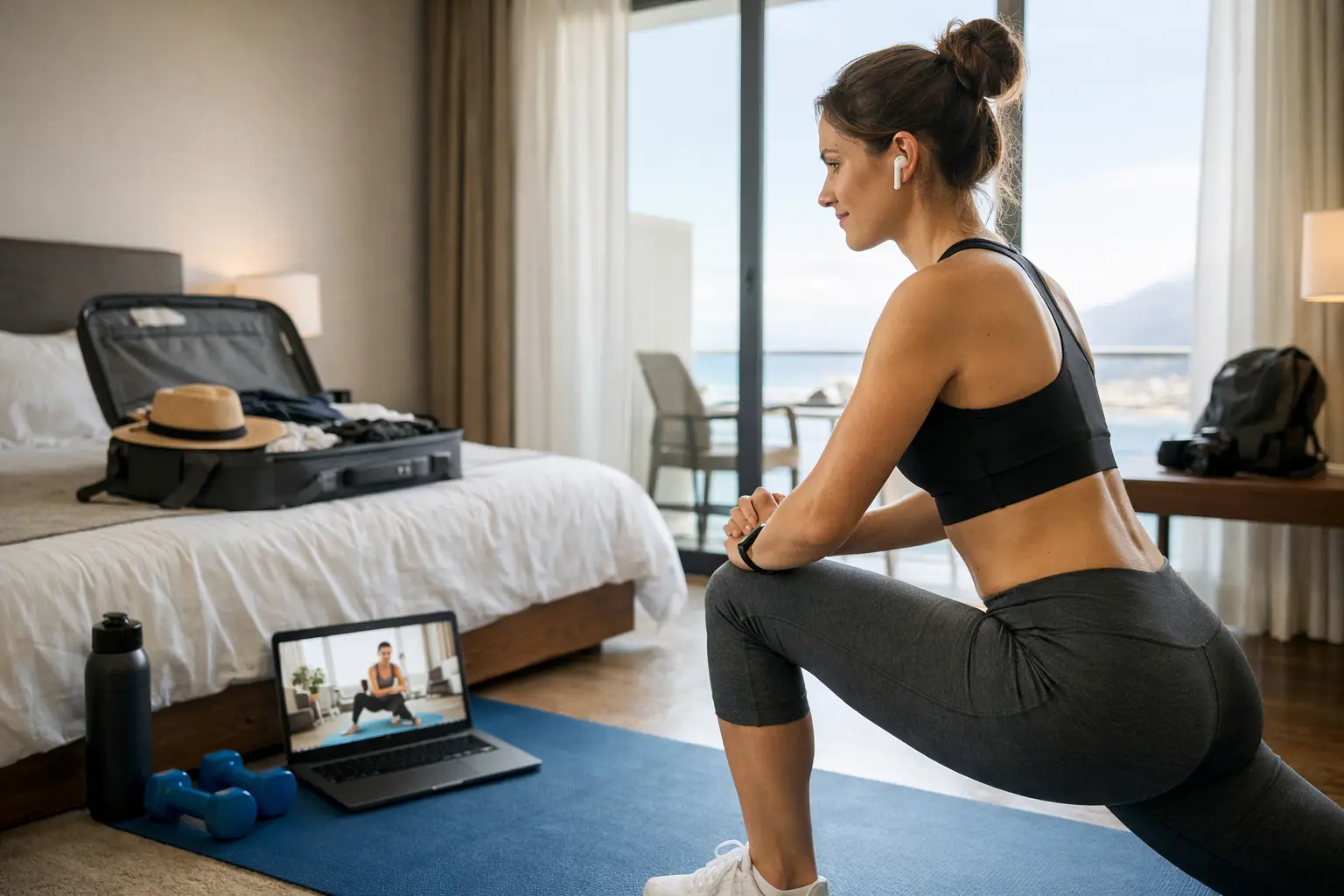
Anyone who travels long-term with family knows this moment: the day was full, the children are finally quiet, your back is making itself known – and yet what's often missing is exactly what was working at least halfway at home. Exercising online while travelling sounds like a good solution at first. No gym to search for, no opening hours to observe, no fixed location. In practice, however, it only works if it fits into real travel everyday life – and not into a wishful vision that collapses again after three days.
That's exactly where the difference lies. It's not the best programme that decides, but whether you can fit it in between accommodation changes, poor WiFi, jet lag, excursions and family life at all. We've often noticed on the road: movement needs less perfection while travelling and more honesty.
Why Exercising Online While Travelling Often Works Better Than Expected
Many associate online training with screen time and living rooms. While travelling it can be surprisingly practical. You don't first have to find out where the next studio is, whether children are allowed in, or whether you'd even feel comfortable in an unfamiliar environment. You press start and get going – in the apartment, on the terrace, next to the bed or for 20 minutes in the morning before the rest of the family wakes up.
For parents in particular this is a big advantage. Travelling with children is rarely plannable. A fixed course at 6 pm sounds good until dinner runs over or a child is suddenly tired, ill or just clingy. Online formats give you more flexibility. You train when it fits your daily rhythm, not when an external provider dictates.
Nevertheless the model has limits. Online sport requires personal responsibility. There's nobody at reception waiting for you and no course group pulling you along. If external structure is important for you, you consciously need small commitments while travelling.
What Really Gets in the Way on the Road
Lack of motivation is usually not the problem, but friction. Too little space, thin-walled accommodation, unstable internet, no mat, no peace. Add to that the mental load. While travelling, much is new, and precisely for that reason every additional decision feels more exhausting than at home.
That's why exercising online while travelling often fails not during the training itself, but before it. Which session suits today? Is the WiFi sufficient? Where do I put my phone? Can I jump without someone below me knocking on the ceiling? When every session first builds ten hurdles, it quickly gets dropped in everyday life.
The better question therefore is not: which programme is perfect? But rather: what is so simple that I'll actually do it despite travel chaos?
Exercising Online While Travelling Requires Different Expectations
Many start with the ambition of taking their usual sport routine along one-to-one. Four workouts per week, 45 minutes each, perhaps also mobility and running training. That can work if you travel slowly, have good accommodation and movement already firmly belongs to your everyday life. For most families it sets the bar too high.
On the road, discipline alone rarely carries you. What carries you is a realistic framework. Perhaps it's not four big sessions but three short ones. Perhaps you replace an intensive workout with a long walk, swimming or a strength session with your own bodyweight. That's not a step backwards, but adaptation.
Those who travel long-term don't need a heroic two-week phase. You need something that doesn't immediately collapse after the next change of location.
The Best Form of Training Is Often the Unspectacular One
While travelling, formats that need little preparation usually win. Short strength training without equipment, mobility sessions, yoga, pilates, core workouts or gentle full-body programmes often work better than demanding setups requiring lots of space.
HIIT can be great, but not every accommodation is made for it. If other guests are sleeping below you or the child next door has just fallen asleep, a quiet training session quickly becomes more valuable than a perfect one. It's worth choosing programmes that work without jumping, without equipment and in a small space.
How to Build a Routine That Holds While Travelling
The most important lever is not motivation but standardisation. If you decide anew every day whether, when and how you train, it becomes exhausting. It gets easier if you define a few fixed rules for yourselves.
For example: training lasts a maximum of 20 minutes. Or: sport only happens in the mornings. Or: on travel days there's no obligation, but a short session the day after. Such simple guardrails take pressure away and create clarity.
An honest approach helps with children too. Don't pretend there are suddenly perfect quiet windows. Sometimes you train with interruptions. Sometimes a child joins in, sometimes one climbs in between. That's not ideal, but often more realistic than waiting for the one magical moment.
Keep Technology Small
The less you need, the better. A smartphone or tablet is often completely sufficient. Headphones can be helpful but don't have to be. If you're staying in one place more often, a lightweight travel mat can make sense, but it's not essential. A towel will do in a pinch.
More important than accessories is preparation. Download sessions when possible. Save two or three favourite formats rather than searching anew every day. And test once how much space you actually need. Many only discover on the road that two square metres are already enough.
Work With the Daily Rhythm, Not Against It
Family everyday life while travelling has windows. Perhaps early in the morning while one parent has breakfast with the children. Perhaps at midday in a quiet phase. Perhaps in the evening, but only with quiet sessions. Those who know these windows train more relaxed.
It becomes difficult when sport always has to slip into the last free gap. Then tiredness almost always wins. Better is a clear place in the day, even if it's small. Fifteen consistent minutes beat a perfect hour that never happens.
Which Online Offerings Really Make Sense While Travelling
Not every training suits travelling. Good ones offer short sessions, different difficulty levels and little material required. Also practical are programmes with clear structure, so you don't have to think anew every day.
When you're travelling as a family, it's also worth paying attention to flexibility. A rigid 12-week plan can be motivating, but only if your travel life is currently calm enough for it. In more eventful phases, libraries with freely selectable sessions are often more relaxed.
It also depends on your type. Some need a trainer's voice and a fixed plan. Others do better with a few saved videos because they want to stay spontaneous. Both are fine. What matters is not what's theoretically effective but what you use regularly.
When Travelling Itself Is Already Movement
There are phases where everyday life on the road is physically enough. Exploring new cities on foot, swimming a lot, carrying, hiking, climbing stairs, being outside with children – all of that is movement. Not every travel chapter additionally needs an ambitious sport plan.
That's not a free pass to ignore physical complaints. Especially the back, shoulders and hips often benefit from targeted short sessions. But it takes pressure away if you can distinguish between general activity and conscious training. Sometimes the body needs more load, sometimes more balance.
This honesty is crucial especially on long-term trips. Those who want everything at once – full travel days, intensive family time, work and top fitness – often overextend their system. Better to adapt sport to the travel phase.
Our Most Honest Tip: Don't Plan for Your Ideal Self
Plan for the version of yourselves that is tired, arrives at an unfamiliar accommodation and actually only wants to shower in the evening. If your sport plan still seems manageable then, it's probably good.
That's exactly why small formats so often work better. Ten minutes of mobility, twenty minutes of strength, a short stretch after a long travel day – that sounds unspectacular but adds up. And it keeps the thread. Those who keep the thread also find it easier to get back into longer routines after stressful weeks.
At Family on World Trip that was again and again the point: not the perfect fitness phase makes the difference, but whether movement gets its place in real life. With children, with changes of location, with everything that belongs to it.
So if you want to start exercising online while travelling, don't start big. Start in a way that you'll still be doing it in three days. That seems less spectacular but usually gets you much further.