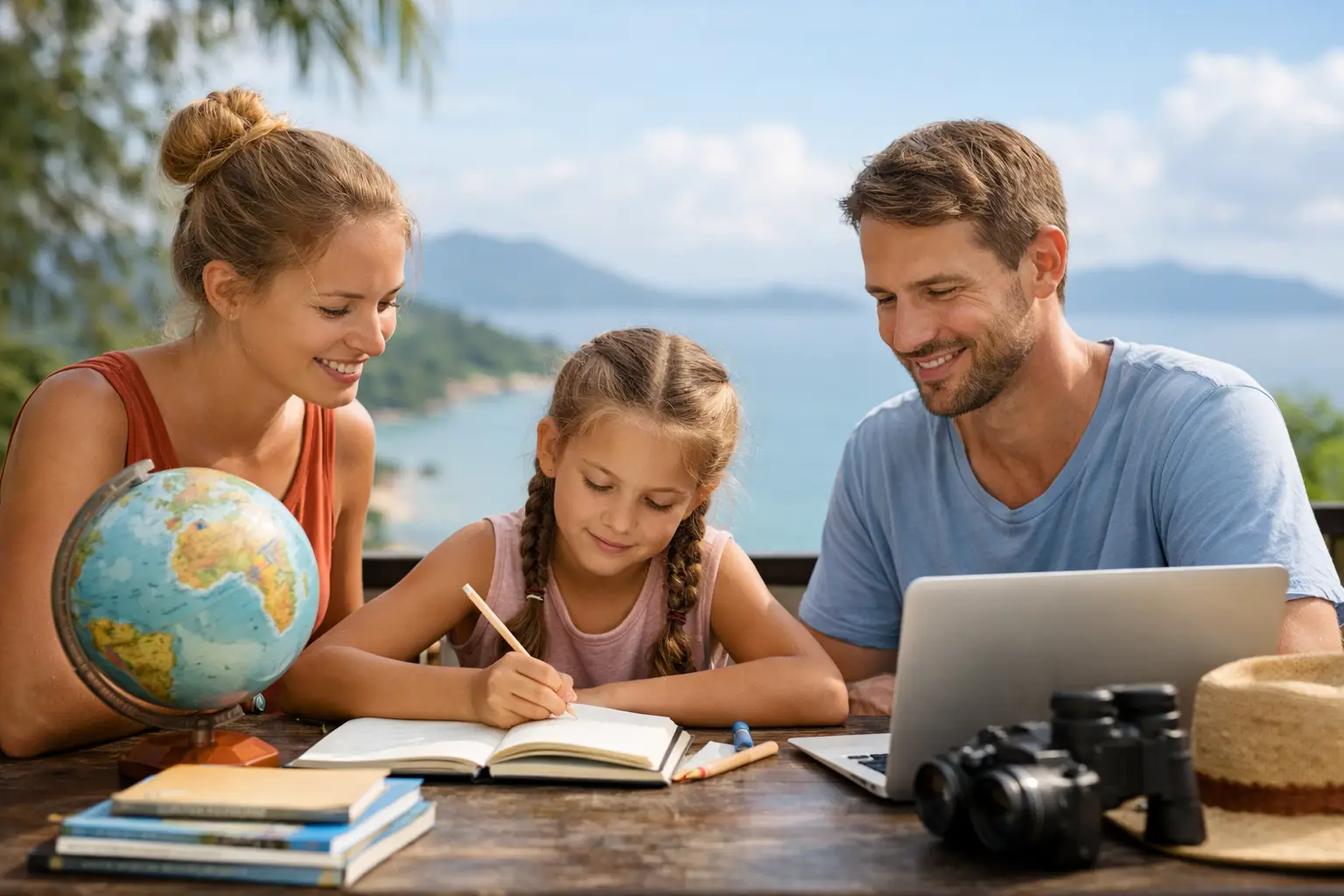
A child sorting shells on a beach by size is learning no less than one sitting at a desk. They’re just learning differently. The real question therefore isn’t how do kids learn while travelling, but how we as adults recognise what’s already happening – and how we give it a reliable framework.
Since we’ve been travelling as a family, we keep experiencing the same thing: on the road, learning doesn’t emerge automatically from beautiful surroundings. New places can spark curiosity, but they can also overwhelm. Long travel days, unfamiliar languages, tiredness, conflict and the question of where the next supermarket is belong to the experience just as much as temples, coral reefs and meaningful encounters. Learning while travelling works well when it fits into real everyday family life – not when we try to transplant school directly into a campervan, a holiday apartment or a rucksack.
How Kids Actually Learn on the Road
Children travelling learn most readily from things that have genuine meaning for them. They calculate when paying in an unfamiliar currency, read timetables, navigate with maps, compare prices, order food and ask when they don’t understand something. That’s not a gap between two lesson periods. That’s applied knowledge.
On a world trip, experiences arise that resist any worksheet: how do I show respect when the rules are different? What does it mean when water is scarce? Why do people in one country live so differently from us? Children hear languages, observe social differences and discover that their own normality is just one of many. This shift in perspective is a significant educational gain.
Even so, it would be too simple to claim that travel alone replaces all forms of structured learning. Some children immerse themselves enthusiastically in everything happening around them. Others need repetition, quiet and clear prompts to keep up with reading, writing or maths. Both are completely fine. What matters is seeing the individual child rather than chasing an idealised image of the travelling learner.
Using Daily Travel Life as a Learning Space
The best learning moments can rarely be planned. But we can recognise them and give them space. If a child wants to know how volcanoes form, the conversation in front of an actual volcano is often more valuable than a perfectly prepared natural science unit a week later. If you’re shopping at a market, children can help calculate, estimate quantities and check the change.
The daily logistics of travel also offer surprising material. Who packs for a move? How many kilometres can the family realistically manage? What does a night’s accommodation cost? Which groceries will last three days? Children take on responsibility and notice that their decisions have consequences. This strengthens not just maths and language, but also a sense of self-efficacy.
A small travel journal can capture all of these impressions. It doesn’t need to be a beautifully designed notebook. A few sentences, drawings, ticket stubs, photos with brief captions or a voice note is enough. Children who prefer not to write in full sentences sometimes communicate better through images. Those who love writing can turn observations into small stories. This is how experience gradually becomes memory, organisation and reflection.
Don’t Squeeze Learning Out of Every Moment
This freedom has a flip side: when every bus ride becomes a maths problem and every museum visit becomes a quiz, travel loses its lightness. Children also need times when they can simply splash in a pool, read comics, sit with boredom or play football with other children. Play isn’t filler. It’s an important part of their learning.
So instead we ask ourselves: what is our child actually engaged with right now? Sometimes that sparks a project. Sometimes the right answer is: nothing extra today. Especially after a flight, a border crossing or several intense days, rest is often more valuable than the next learning plan.
A Light Framework Provides Stability
Many families feel more grounded when they consciously attend to a few core areas. For us, reading, writing and maths are the foundational pillars, because they help children access knowledge independently. On the road, surprisingly little material is needed for this: a book, a notebook, pencils, a card game, small calculation challenges and digital content when needed.
More important than the amount is regularity. Some families do one learning hour each morning before setting out. Others take travel days off and use quieter weeks in one place for more concentrated periods. When children are different ages, it’s worth not making everyone do the same thing at the same time. A pre-schooler learns through play and movement; a primary school child might do well with short, clear sessions; a teenager increasingly needs their own themes and responsibility.
A weekly rhythm often works better than a rigid daily timetable. At the end of each week, look together at what you’ve encountered and what questions are still open. That might turn into a research project about sea turtles, a calculation about the travel budget, or a piece of writing about a first diving experience. This keeps learning connected to what you’ve actually lived.
When Motivation Disappears
There are those days: the child doesn’t want to write, you’re irritated, an outing is waiting outside, and a small task has turned into a power struggle. Applying more pressure rarely helps in these moments. Behind resistance there’s usually something specific – tiredness, homesickness, uncertainty, material that’s too difficult, or simply the need for some say in what’s happening.
We first try to reduce the demand. Instead of a full page, three sentences are enough. Instead of mental arithmetic, a round of cards. Instead of a factual text, the child looks carefully at a place and tells you about it later. Small successes tend to achieve more than a plan pushed through that takes the joy out of everything.
Of course there are also tasks nobody wants to do. We know that from every family’s ordinary life. In those cases a clear framework can stay in place: a manageable learning period, then we move on. Freedom doesn’t mean everything is always comfortable. It means consciously deciding what actually sustains your family right now.
School, Compulsory Education and the Reality of Travel
Alongside all the enriching experiences, an honest question belongs here: how is your trip organised legally? In Germany compulsory schooling applies as a general rule. A longer trip with school-age children therefore needs early, individual clarification with the relevant school and authority. An exemption is not automatic, and regulations can differ between federal states and individual cases.
This isn’t a detail to address the week before departure. Start the conversation in good time, prepare your plan comprehensibly and remain open to requirements. Some families travel within officially clarified periods; others choose a change of registered address or different educational arrangements. What’s possible and appropriate depends on your individual situation. Travel experiences and private learning are not automatically equivalent to legally recognised home education.
This clarity also creates emotional space. Once the organisational framework is in place, you don’t have to prove every day on the road that your children are learning enough. You can look more carefully at what they actually need.
What Travelling Makes Children Exceptionally Good At
On the road children don’t just learn facts. They practise dealing with change. They find their way in unfamiliar places, experience plans shifting, and discover their own solutions. This can be extraordinarily strengthening – provided they’re not burdened with all the adults’ uncertainties too.
That’s why reliable anchors are part of good travel education. A favourite book in the rucksack, a familiar bedtime routine, regular contact with friends or grandparents, and small decision-making rights in the planning all provide stability. The younger the child, the more important these anchors become. Adventure needs roots.
We’ve learnt: not every day has to be extraordinary to be valuable. A slow morning in the apartment, cooking together or a conversation about what’s currently difficult can shape children just as much as a major excursion. On the road they learn that the world is wide. And that they’re allowed to find their own place within it.
So when you set off, don’t take with you the expectation of having to create a perfect learning environment at every moment. Take curiosity, a little structure and the courage to keep reshaping your family everyday life as you go. That’s often exactly where the learning that stays lives.