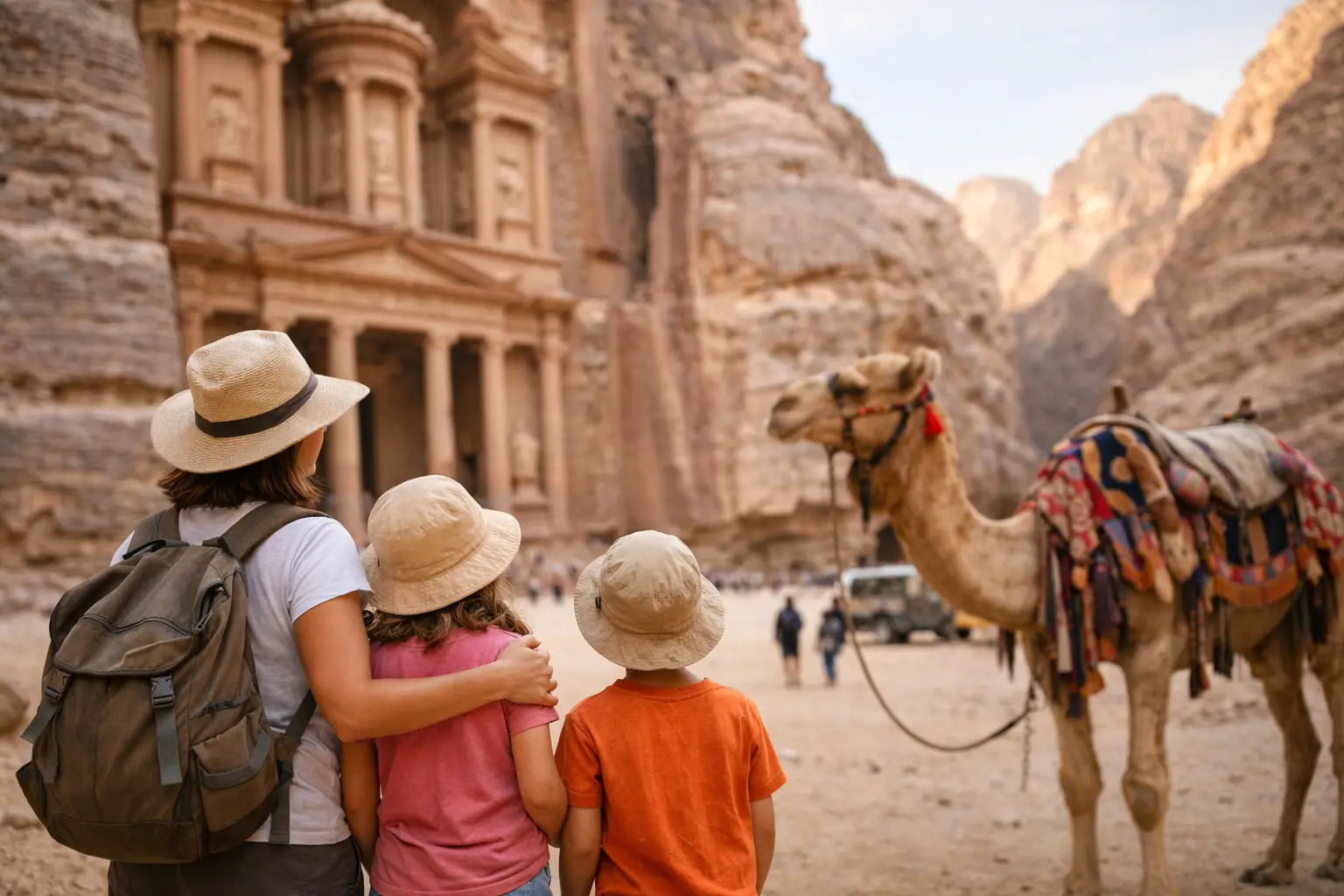
Petra in the first morning light, sand in your shoes after a night in Wadi Rum, and children suddenly laughing in the Dead Sea because they simply can’t sink: our experience travelling Jordan with kids was intense, surprisingly relaxed, and considerably less complicated than many parents expect. Jordan isn’t a passive resort destination. But for families who want to genuinely experience something together, it’s a country with a remarkable combination of adventure, warmth and manageable distances.
Especially if you’re planning your first longer trip with children or are already some months into family travel, Jordan can be a powerful introduction to the Middle East. The journey requires a little planning, but rewards you with moments your family will still be talking about years later.
Jordan With Kids: Between Adventure and Everyday Life
The best news first: children in Jordan aren’t merely tolerated – they’re visibly welcome. In restaurants, small shops and guesthouses, conversations start quickly, often without any shared language. A smile, a wave, or a curious question about the children’s ages is usually enough.
This openness takes a lot of the tension out of travelling. Anyone who’s travelled with children knows the situation: one child is tired, the other is hungry, and the order is taking longer than usual. In Jordan we found people remarkably patient and helpful in these moments. That doesn’t mean every leg of the trip is automatically easy. But it does mean you don’t constantly feel out of place just because of normal family chaos.
At the same time, Jordan isn’t a country to rush. The major sights do lie on a plannable route, but heat, driving times and the sheer volume of impressions cost energy. Trying to fit Amman, Jerash, the Dead Sea, Petra, Wadi Rum and Aqaba into five days turns a family trip into a logistics project. With eight to ten days the whole thing becomes significantly more relaxed.
Petra Is Magic – If You Plan the Day Wisely
Petra is for many families the main reason to visit Jordan. And yes: walking through the Siq – the narrow canyon passage – until the famous Treasury suddenly opens before you works with children. Perhaps especially well, because children haven’t yet loaded the moment with expectations. They simply see a vast city carved from rock, and they find it extraordinary.
The challenge lies less in Petra itself than in the length of the day. From the entrance to the Treasury is already a substantial walk, and the site is far larger than most photos suggest. Younger children benefit from a very early start, sufficient breaks and realistic expectations about how far you’ll go. You don’t have to see every viewpoint and every monastery for Petra to remain in memory.
Bring more water than you think you’ll need, along with snacks, sun hats and sturdy shoes. The ground is uneven, and steps become exhausting in sandals. For babies and very young children a comfortable carrier is usually more practical than a pushchair. An off-road buggy can work on some paths, but becomes awkward in the narrow and rocky sections.
A tip from family travel experience: don’t plan a major programme item after Petra. Accommodation in Wadi Musa, a quiet dinner and an early night are not wasted travel time. They make sure the next day doesn’t begin with exhausted children and frayed adults.
Wadi Rum: The Night in the Desert Stays With You
If Petra is the famous image of Jordan, Wadi Rum is often the most emotionally memorable part of the trip. The red desert, the towering rock formations and the vast silence feel to children like a film set come to life. A jeep tour across the sandy tracks is exciting, but depending on age and temperament, also quite wild. Ask beforehand for a family-friendly tour and be open about travelling with young children. Not every high-speed run across the dunes is necessary.
Spending a night in a desert camp is exactly the kind of experience where less is more. One night is enough for most families. Playing in the sand in the afternoon, watching the sunset, eating together and counting stars in the evening – this doesn’t need a packed additional programme.
The important thing is managing expectations: even comfortable camps are in the desert. It can be windy, cold or very warm; the paths are sandy; and not every bathroom meets European hotel standards. That’s precisely part of the appeal. Families who arrive with the attitude that not everything has to be spotless generally have the better hours.
Dead Sea and Aqaba: The Quieter Counterpoints
After Petra and Wadi Rum, a slower day does everyone good. The Dead Sea is a wonderfully strange experience for children: they sit in the water and realise they’re simply being held up. Keep young children close beside you. The water is extremely salty and a splash in the eyes ends the fun immediately.
Open wounds, freshly shaved skin or eczema can sting painfully in the salt water. Freshwater showers within reach are therefore invaluable. A hotel or beach club can make life considerably easier here, providing shade, showers and comfortable access to the water.
Aqaba on the Red Sea fits well at the end of the route if you want a few beach days. Snorkelling from the shore can be a genuine highlight for older children. With younger children, a pool, a short boat trip or an afternoon with no agenda often counts just as much. Freedom while travelling doesn’t mean taking every possible excursion.
Assessing Safety in Jordan Realistically
The safety question comes up almost immediately. Our impression: Jordan feels calm, organised and welcoming in daily life. As a family you stand out, but in a positive way. That said, the country sits in a geopolitically sensitive region. The situation can change, so checking current travel advisories before departure is just as important as getting appropriate travel health insurance.
Within the country, the practical risks are often far more mundane than the headlines suggest: traffic in Amman, heat, long car journeys and insufficient water. The driving style in cities in particular can be challenging at first. Those who don’t want to drive themselves can hire a driver for individual stretches or the whole circuit. This costs more than a hire car but noticeably reduces stress.
If you hire a car, ask about child seats early and don’t rely on availability at pick-up. Depending on your children’s ages, it may be worth bringing at least a booster seat with you. Avoid driving on unfamiliar rural roads at night, build in generous breaks and allow much more time than the map suggests for city driving.
Food, Budget and the Small Things That Really Matter
Jordanian food is more child-friendly than many expect. Flatbread, hummus, rice, grilled chicken, falafel, chips and fresh fruit work well for most children. If you have very picky eaters, you still won’t find a favourite dish every single day. A few familiar snacks in the daypack prevent unnecessary arguments precisely when energy is already low.
On budget, it depends a lot on how you travel. A hire car, good accommodation and organised tours make Jordan a reasonably costly destination for Western families. At the same time, you save time and stress when transfers, overnight stays and special experiences are reliably organised. For us on a family trip that’s often the right calculation: look not just at price, but at what genuinely makes life easier on the road.
Jordan doesn’t demand experienced travellers. It suits families who are willing to open themselves to new smells, unfamiliar rhythms and a different pace. Don’t plan every hour; leave space for breaks; take the pressure off seeing everything. When you do that, a trip to famous places becomes something much more valuable: shared memories in which your children weren’t just present, but right at the heart of it.