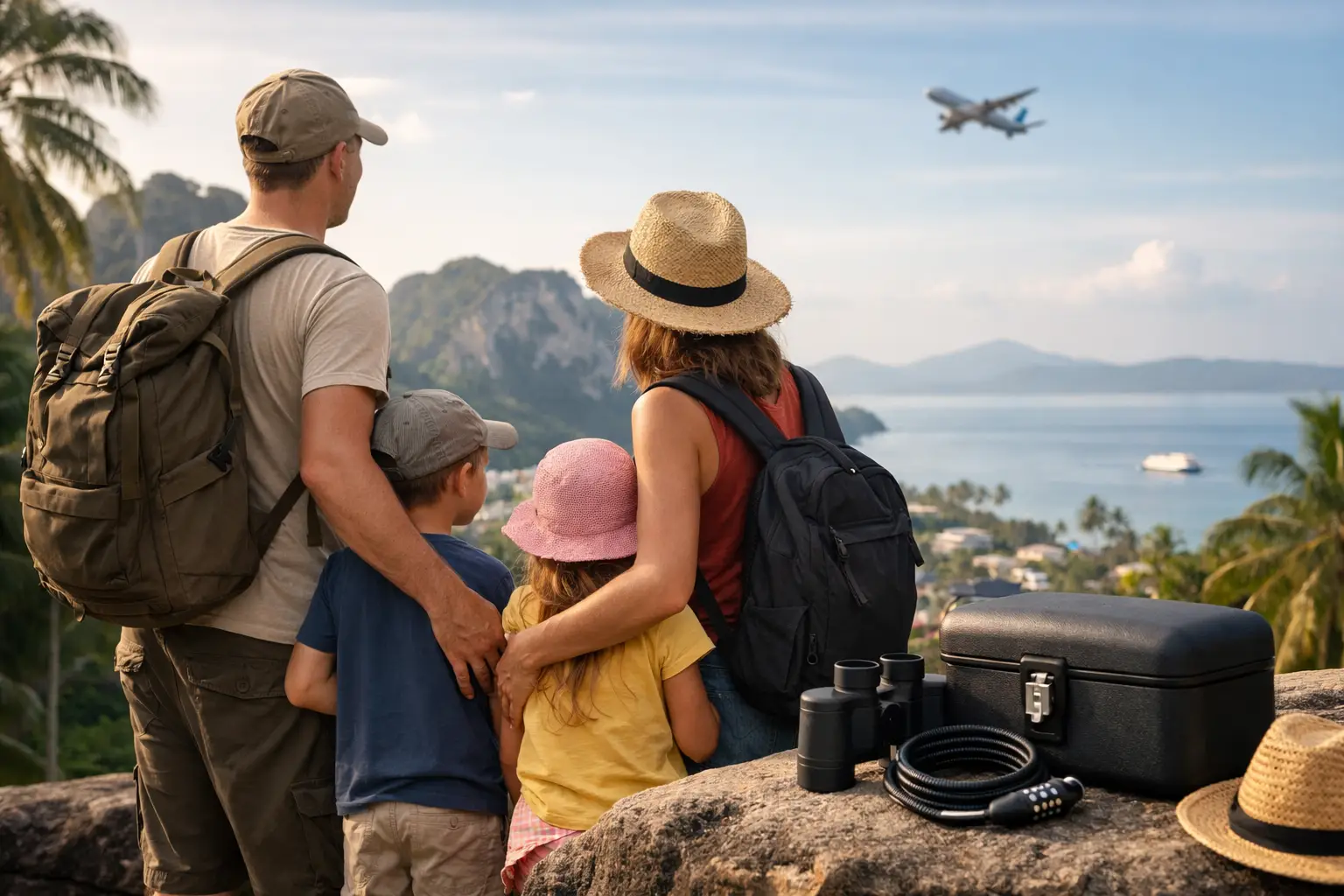
The question about safety on a world trip with children comes up almost always early. Usually even before route, packing list or budget. And honestly: that's right too. Because with children you don't just travel differently – you decide more consciously, look more carefully and quickly notice that safety doesn't mean switching off every risk. It's about understanding risks, making good decisions and remaining capable of action as a family.
Those who travel long-term with children quickly notice: the biggest dangers are often not the spectacular things others warn about. Much more frequently they are tiredness, hectic activity, overwhelm, poor transport decisions or accommodation that looks beautiful in photos and is impractical on location. Safety therefore rarely arises through control, but through routines and preparation and the honest admission that not every place, not every time of day and not every adventure suits your family right now.
Safety on a World Trip with Children Begins Before Departure
Many parents search for the one right answer: which countries are safe? Which vaccinations are needed? What belongs in the travel first aid kit? All of that belongs to it, but the decisive part begins earlier. Namely with your way of travelling.
If you permanently overwhelm yourselves, constantly move on and push every location change to the maximum, your safety automatically decreases. Not because of the country, but because of your state. Families often travel more safely when they travel more slowly. More nights in one place, fewer night journeys, breaks between transport days and accommodation where you can orientate yourself quickly make an enormous difference in everyday life.
Route planning should also not function only according to places of longing. A country can be beautiful and still not suit your family constellation right now. You travel differently with a toddler than with school children or teenagers. Rainy season, heat, medical provision, road traffic and language barriers are not secondary matters. They co-determine how safe your everyday life on the road feels.
Country Choice: Safe Is Not the Same for Every Family
One of the most honest answers to the question of safety on a world trip with children is: it depends. Not evasively, but realistically. Some families feel most comfortable in countries with good infrastructure, clear rules and a stable health system. Others manage very well in simpler regions when they travel more slowly there and make conscious decisions.
More important than a blanket ranking is your personal safety profile. How experienced are you at travelling? Are you travelling with a baby, several children or alone as one parent with children? Can you spontaneously rebook in an emergency? How well do you deal with uncertainty? Those who take these questions seriously don't plan more anxiously, but more cleverly.
On our travels we've repeatedly experienced that places feel completely different on location than from the outside. A country with a bad reputation can be surprisingly relaxed in family everyday life. A supposedly easy travel destination can on the other hand become stressful if traffic, noise or crowds permanently drain you. Therefore don't only listen to headlines, but to reliable information and your own feeling.
Being Safe on the Road Often Means: Building Good Everyday Life
Most safety questions are decided not in exceptional cases, but in the daily routine. Where do you stay? How do you get from A to B? When do you eat? How tired are the children? Do you have reception, cash and a plan B?
Accommodation doesn't need to be luxurious for families, but practical. Windows and balconies, street location, lockable doors, cooking facilities, clean water within reach and enough space so that not everyone is on top of each other are often more important than design. If you arrive and notice something doesn't feel right, don't stay out of principle. One night in an uncomfortable place sometimes costs more nerves than a spontaneous change costs money.
Transport follows similar logic. Night buses, tight connections and arriving in the dark can work, but don't have to. With children the cheapest way is not automatically the best. Better to arrive during the day, pay a little more and have orientation as a result. These decisions seem small but change the entire feeling of safety.
Health Is a Safety Factor, Not an Extra Topic
Many think of crime first when thinking about safety. With children we often think of health first. Fever in an unfamiliar city, dehydration, stomach problems or an unfortunate injury immediately bring dynamic to the day. That's why preparation that really suits you is worthwhile.
This includes a well-thought-out travel first aid kit, but also knowledge. Which medications do you know and can you administer safely? What do you do with diarrhoea, when does fever become critical, how do you organise medical help in an emergency? The best equipment is of little use if you don't act clearly in stressful situations.
Equally important is prevention. Drinking enough, sunscreen, mosquito protection, not approaching food unnecessarily riskily and watching for exhaustion – that sounds banal, but prevents an astonishing number of problems. Children often notice earlier than adults when something is becoming too much. Those who listen to this, rather than pushing through the plan, usually travel more safely.
Documents, Money and Digital Safety
An underestimated part of safety on a world trip with children is everything organisational. Lost passports, blocked cards or missing documents are rarely dramatic in the grand sense, but they can put a family under pressure very quickly.
It's helpful to think of important documents in duplicate. One set close to the body or safely in luggage, digital copies, clearly stored emergency contacts and a common understanding of who has what with them. With money too, a division relaxes. Not everything in one place, not only one card, not only one account, not only one payment method.
Digital security sounds less like travel adventure, but has long belonged to it. Secure passwords, devices with a lock, not leaving important data lying around openly and being careful with public networks – that's not a luxury, but part of a stable system. Especially when your entire family life runs via bookings, banking and communication.
Strengthening Children Rather Than Just Protecting Them
A point that changes an enormous amount in family travel everyday life: children don't only need protection, but orientation. Safety also arises through children understanding age-appropriately what is important in certain situations.
Small children can learn to stay within sight at stops and to wait at a fixed place in case of doubt. Older children can know names, accommodation or telephone numbers, know who to turn to and how to react if they briefly lose you. Teenagers need not just rules, but real conversations about traffic, going alone, social media, strangers and peer pressure.
The goal is not to make children mistrustful. It's about giving them safety as a capability for action. Those who take everything away from children protect them short-term. Those who involve them make them safer long-term.
Gut Feeling Is Not an Alternative to Preparation
Many parents doubt themselves because they can't distinguish between genuine intuition and travel anxiety. That's normal. But it's worth taking seriously. If a situation feels strange, you don't first need to logically defend it. You're allowed to cancel, replan, stop, leave.
At the same time, gut feeling is stronger when it doesn't come from permanent stress. Those who are well-rested, decide on the basis of information and speak as a team can perceive warning signals better. That's why communication and honesty belong in every family trip. Not only the child is allowed to say something is too much. Parents too are allowed to admit when they feel unsure.
Finding Your Own Line Between Freedom and Caution
World travel with children doesn't mean only watching for dangers. Children should climb, swim, discover, play with others and experience that the world is bigger than their home. Safety must not devour freedom. But freedom without responsibility quickly tips into carelessness.
The good news is: you don't need to travel perfectly to travel safely. You don't need to have everything under control either. What you need is a clear line. Which situations do we avoid? Where do we make compromises? When do we spend more money because it's the better decision? And how do we notice that we're currently not courageous, but overtired?
That's often where the greatest strength of travelling families lies. You don't become less fearful over time, but clearer. You learn what really matters. Not the perfect route, not the coolest story, not the feeling of being able to do everything. But this calm, reliable form of safety that carries you through everyday life.
When you set off with children, it's not despite responsibility, but right in the middle of it. And perhaps that's exactly the most beautiful truth about this topic: safety on a world trip with children doesn't arise when you make yourselves small. It arises when you prepare, remain attentive and trust yourselves as a family to make good decisions.